
Managing inventory often feels like a tightrope walk. When your stock control system isn’t optimized, you risk either overstocking, tying up cash in excess inventory, or facing stockouts that leave customers empty-handed.
In fact, poor inventory management causes businesses to lose up to 11% of their annual revenue on average, mainly due to stockouts and overstocking. Both problems lead to lost revenue and frustrated customers.
In this article, we’ll share practical strategies to fine-tune your inventory system, ensuring you maintain the right balance that is enough stock to meet demand without overspending.
Stock control, also known as inventory control, refers to the process of managing the quantities of goods in a business’s inventory to ensure optimal stock levels. It involves tracking inventory movement, ensuring timely restocking, and managing the flow of products to meet customer demand. Effective stock control is crucial for businesses to run smoothly and maintain customer satisfaction.
The primary objective of stock control is to balance supply with demand. Effective stock control ensures that businesses avoid overstocking, which ties up cash, and stockouts, which lead to lost sales. Both of these scenarios can be detrimental to a business:
Through careful planning, data analysis, and accurate forecasting, stock control enables businesses to maintain the optimal level of stock, ensuring that customer demand is met without unnecessary delays or surplus inventory.
Before examining the methods of stock control, it is essential to distinguish between stock control and inventory management. While both aim to optimise stock levels, they play distinct roles in the supply chain, enabling businesses to balance supply and demand effectively.
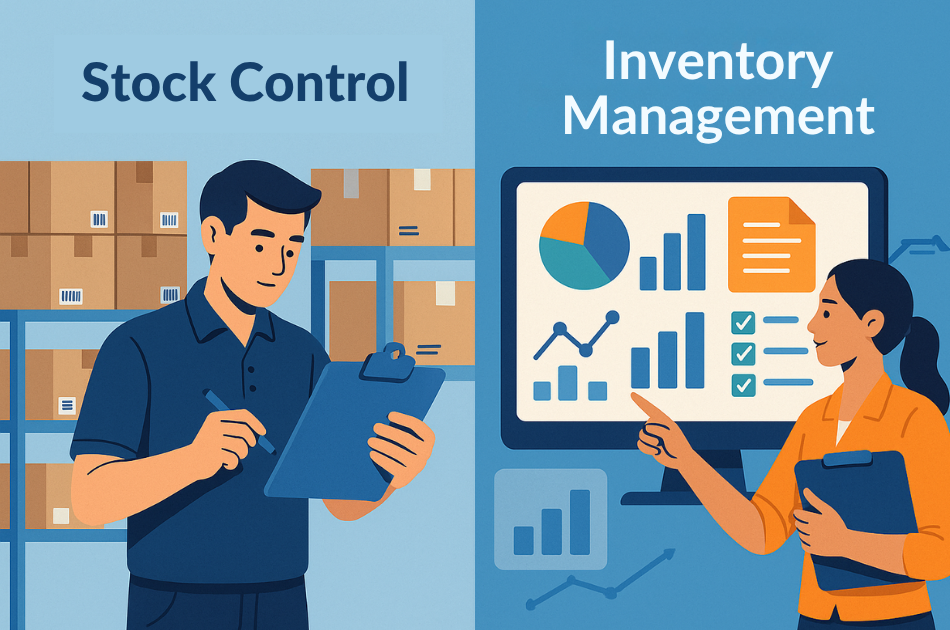
Stock control and inventory management are terms that are often used interchangeably, but they play distinct roles within a business’s operations. Both are critical to maintaining smooth operations, but address different inventory management aspects.
Here’s how they differ:
While stock control focuses on maintaining optimal inventory levels to meet immediate customer demand, inventory management is a broader, more strategic approach that oversees the entire lifecycle of inventory, from procurement to final sale.
| Aspect | Stock Control | Inventory Management |
| Focus | Focuses on monitoring inventory levels to avoid stockouts or overstocking. | Covers the entire process of procurement, storage, and distribution of inventory. |
| Scope | Primarily concerned with ensuring that inventory levels are sufficient to meet customer demand without excess. | Encompasses demand forecasting, supplier management, ordering, and the overall distribution process. |
| Key Objective | Maintains optimal stock levels, balancing supply and demand. | Ensures a smooth inventory flow through planning, tracking, and managing stock across multiple channels. |
| Processes Included | Stock monitoring, inventory tracking, and replenishment. | Procurement, order fulfillment, stock control, and demand forecasting. |
| Impact | Affects operational efficiency by maintaining ideal stock levels. | Affects all stages of the supply chain, from purchasing to sales, to improve overall business performance. |
Now that we understand the distinction between stock control and inventory management, it is essential to grasp the pivotal role stock control plays in business success.
Also Read: How to Track Inventory: Steps and Tips
Effective stock control has a direct impact on a business’s profitability, customer satisfaction, and operational efficiency. By maintaining optimal inventory levels, businesses can meet customer demand while reducing waste and inefficiencies.
Here are the key benefits of implementing an effective stock control system:
By mastering stock control, businesses not only safeguard profitability but also ensure a smooth customer experience, fostering loyalty and satisfaction.
Strong stock control opens the door to smarter, more agile operations. So, how do you get there? Let’s look at the methods that can make it happen.
Looking to improve your stock control systems and manage your operations? Contact Inspire Solutions Asia today for tailored inventory management solutions that help you optimize stock levels and drive your business growth!
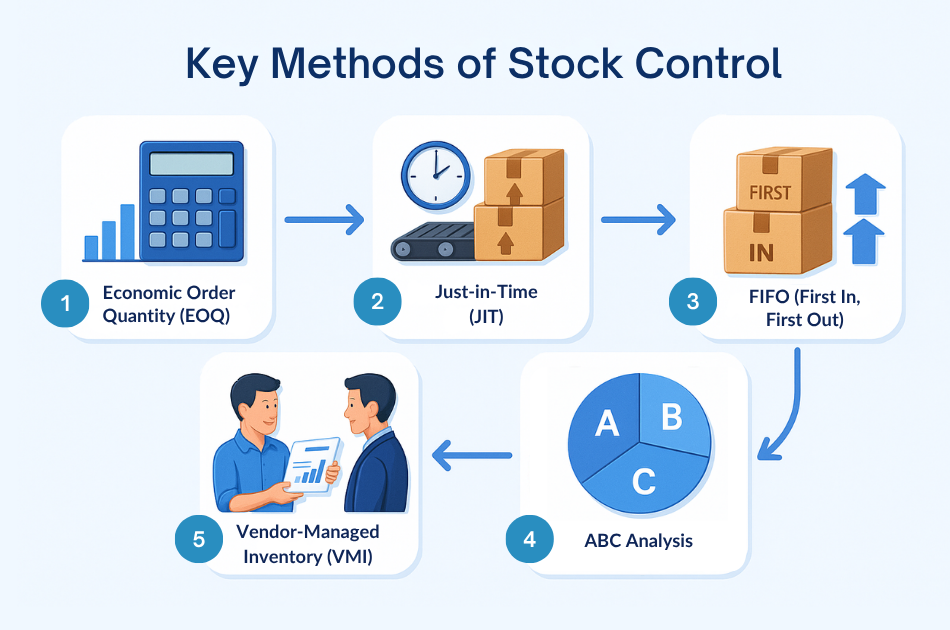
Getting stock control right is essential for meeting demand, reducing waste, and keeping costs in check. But there’s no one-size-fits-all approach. Different products, sales patterns, and storage limitations call for different strategies. That’s why businesses rely on a mix of stock control methods each designed to solve specific inventory challenges.
Here’s a look at some of the most effective methods used across industries:
Economic Order Quantity (EOQ) is a formula-driven inventory management technique used to determine the optimal order quantity that minimizes total inventory costs. The EOQ formula strikes a balance between ordering and holding costs, ensuring that stock levels are maintained without overstocking or understocking.
EOQ Formula:
EOQ=2DSHEOQ = \sqrt{\frac{{2DS}}{{H}}}EOQ=H2DS
Where:
By applying the Economic Order Quantity (EOQ) formula, businesses can minimize unnecessary inventory costs while ensuring they have sufficient stock to meet customer demand. The result is a more efficient and cost-effective inventory system.
Just-in-Time (JIT) is a method that minimizes stock levels by ordering only what’s needed for production or to meet customer demand. The primary benefit of JIT is the reduction in storage and holding costs since inventory is replenished only when required.
However, JIT relies on accurate demand forecasting and supplier reliability. If forecasting is incorrect or suppliers fail to deliver on time, businesses may experience stockouts.
JIT is most effective in industries with high inventory turnover, and there is minimal variability in demand.
FIFO (First In, First Out) is an inventory management method where the first items received into the inventory are the first ones to be sold or used. This method is particularly useful for businesses dealing with perishable goods, such as food and pharmaceuticals, as it helps minimize spoilage and loss.
For example, suppose a food store receives a shipment of fresh vegetables. In that case, the FIFO (First-In, First-Out) method ensures that the older stock is sold first, reducing waste and ensuring that customers receive fresh products.
ABC Analysis is a method for categorizing inventory based on its importance and sales value. Items are grouped into three categories:
This method enables businesses to prioritize management efforts on high-value products (A-items), while lower-value items (C-items) are monitored less frequently, thereby optimizing resource allocation.
Vendor-Managed Inventory (VMI) involves outsourcing inventory control to the vendor or supplier, who monitors stock levels, orders products, and ensures timely replenishment. The vendor manages stock levels, thereby reducing the business’s need for internal management and allowing the supplier to assume some of the risks associated with inventory management.
VMI helps businesses manage their supply chain, reduce stockouts, and cuts storage costs, as the vendor ensures that stock levels are always maintained at an optimal level.
Effective stock control is about ensuring that your practices align with the needs of your business and its growth trajectory. While methods like EOQ, JIT, FIFO, and VMI are fundamental, the next step is refining your approach through best practices. These will improve your inventory flow and ensure that your stock control systems are efficient and accurate.
Also Read: How to Calculate and Use the Reorder Point Formula
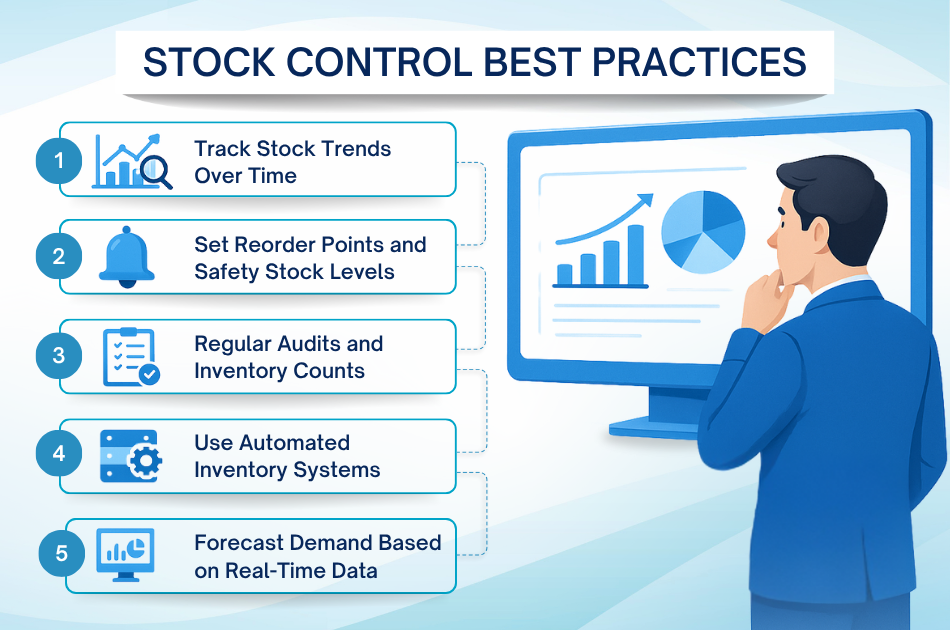
Even the best stock control methods can fall short without the proper supporting practices. From accurate forecasting to regular audits, the consistent habits behind the scenes keep your inventory in check. These best practices don’t just fix short-term issues, they build a resilient system that responds well to demand shifts, supplier delays, or seasonal trends.
Here are some proven practices businesses rely on to strengthen stock control:
Monitoring your stock trends is key to understanding how products move, through your business. By analyzing sales data and observing which products are in high demand, you can more accurately anticipate future needs. This helps you adjust your orders and stock levels accordingly.
Why It’s Important:
Reorder points indicate when to place new orders, ensuring you’re never left without key products. Safety stock refers to the extra inventory held in reserve to protect against unexpected demand spikes or supplier delays. By setting these levels ahead of time, you can keep operations running smoothly and avoid disruptions.
Why It’s Important:
Consistent stock audits are a cornerstone of reliable inventory management. Performing regular cycle counts, where you count portions of your inventory at different times, or conducting a complete physical inventory audit helps ensure the accuracy of your data. These audits help catch errors early, whether it’s due to misplaced stock, theft, or discrepancies in your inventory records.
Why It’s Important:
Utilize the power of automation with inventory management software. These systems can offer real-time stock tracking, automatically update your inventory with each sale, and even generate reports on stock movement. Automation manages the entire stock control process, reducing the time spent on manual tracking and minimizing human errors.
Why It’s Important:
Using real-time data from your sales and market trends allows for more accurate demand forecasting. This includes analyzing past sales, monitoring current market trends, and tracking seasonal fluctuations. With this information, you can make data-driven decisions about when to reorder and which products to prioritize.
Why It’s Important:
By implementing these stock control best practices, you’ll enhance your inventory management process, reduce operational costs, and improve overall business efficiency.
Having discussed best practices to improve stock control, the next critical step is to choose the right stock control system that aligns with your business’s size, operations, and growth plans.
When it comes to stock control, selecting the right system is crucial. There are several systems and tools available, each offering specific advantages based on your business’s needs.
Whether you’re a small business just starting or a large enterprise with complex inventory needs, it’s essential to choose a system that meets your operational requirements.

A key decision to make early on is whether to implement a periodic or perpetual inventory system. Both have their strengths, and your choice largely depends on your business size and inventory turnover. Here is a quick overview table.
| System Type | Periodic System | Perpetual System |
| Definition | Involves periodic physical counts of inventory (monthly, quarterly, or annually). | Continuously updates inventory in real-time as sales and purchases occur. |
| Best For | Small businesses with lower transaction volumes. | Larger businesses or those with high transaction volumes. |
| Cost | Cost-effective and simple to implement. | More expensive to implement. |
| Data Access | Does not provide real-time data. | Provides real-time visibility of stock levels. |
| Key Benefit | Simple to use and ideal for small-scale operations. | Helps avoid stockouts and enables better reordering with accurate, up-to-date data. |
| Drawback | Can lead to stockouts or overstocking due to a lack of real-time data. | Requires more resources and investment to implement. |
Choosing between a periodic and perpetual inventory system is just the beginning. Once you’ve decided on the right approach, the next step is to consider the tools that will help you manage inventory efficiently.
Relying on manual processes or outdated systems can result in inefficiencies and inaccuracies. This is where inventory management software comes into play. With the right software, businesses can automate stock tracking, enhance forecasting accuracy, and gain real-time insights into their inventory levels.
Why is software so important?
Popular inventory management software systems include:
When selecting the right stock control system, consider factors like:
Effective stock control goes beyond just applying the right methods. It’s about adopting practices that smooth your operations and improve inventory management efficiency. By using the right strategies, you can reduce waste and keep everything running smoothly.
Even with the right methods in place, stock control still comes with its own set of challenges. From overstocking to managing perishable goods, understanding these hurdles will help you refine your approach and improve overall efficiency.
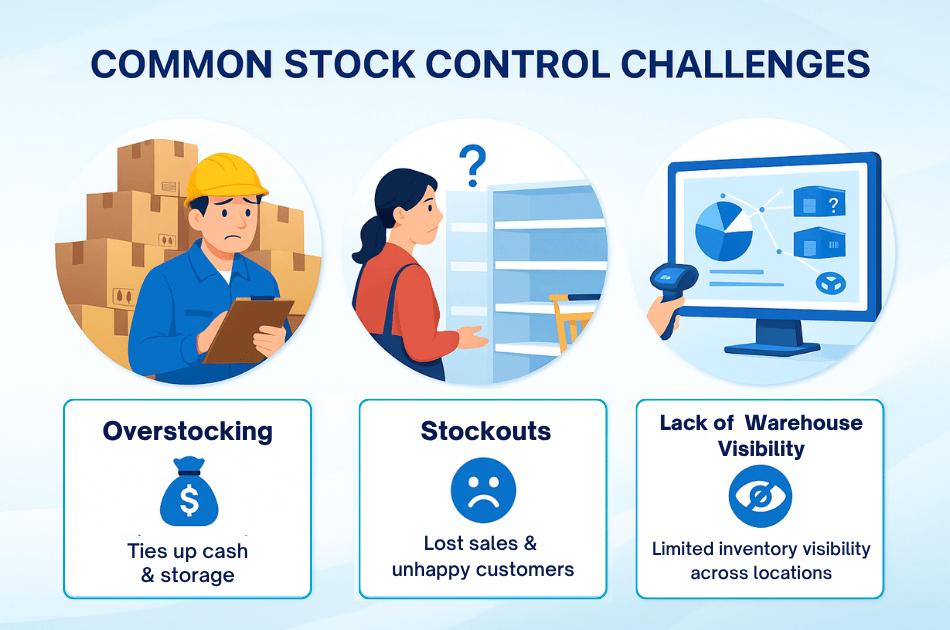
Stock control is crucial to ensure a smooth and profitable business operation. However, as we have seen, businesses face several challenges, ranging from overstocking to managing products with a short shelf life.
But with the right approach, tools, and strategies, businesses can manage these obstacles and optimize stock control. Let’s explore some of the most common issues faced by companies and practical solutions to address them.
Overstocking and stockouts are two of the biggest challenges in stock control. Overstocking ties up valuable cash flow and leads to excess storage costs, while stockouts result in missed sales and dissatisfied customers. The key to overcoming these challenges is finding a balance.
By implementing effective stock control strategies, such as demand forecasting, setting reorder points, and continuously monitoring stock levels, businesses can avoid both overstocking and stockouts.
Products with short shelf lives or those with seasonal demand present additional challenges in stock control. Perishable goods must be closely monitored to avoid waste and spoilage. Businesses should implement the First In, First Out (FIFO) method to ensure that older stock is used or sold first, thereby optimizing inventory management and utilization.
For seasonal products, forecasting and planning are crucial. By analyzing past sales data and using predictive tools, businesses can better prepare for demand surges and avoid the costly mistake of carrying excess stock after the season ends.
As businesses grow, they often expand to multiple warehouse locations. Multi-location management can create visibility challenges, making it difficult to track stock across different locations. To address this, businesses can adopt cloud-based stock control systems that provide real-time visibility across all locations, enabling better decision-making.
With proper inventory management software, companies can manage operations, minimize stock discrepancies, and ensure that products are always available where they are needed.
At Inspire Solutions Asia, we understand the complexities of stock control and the challenges that come with it. Our expert team provides customized solutions to help businesses effectively manage their warehousing and inventory management processes.
From multi-location stock visibility to precise order fulfillment, our integrated system enables you to overcome common challenges and optimize your stock control.
Get a quote today to discover how we can help you enhance your stock control processes and propel your business forward.
Staying ahead of the emerging trends in stock control is more important than ever for businesses that are growing to keep a competitive edge. These trends can significantly improve efficiency, reduce costs, and enhance customer satisfaction.
The warehousing and cold chain market in the Philippines is growing rapidly, with a projected compound annual growth rate (CAGR) of 6.34% between 2019 and 2024, according to Makreo Research.
This expansion is primarily driven by the country’s strategic location and the surge in e-commerce demand, which in turn has increased the need for more efficient and reliable logistics infrastructure. The need for optimized stock control is thus paramount to meet the increasing demands and ensure smooth operations.
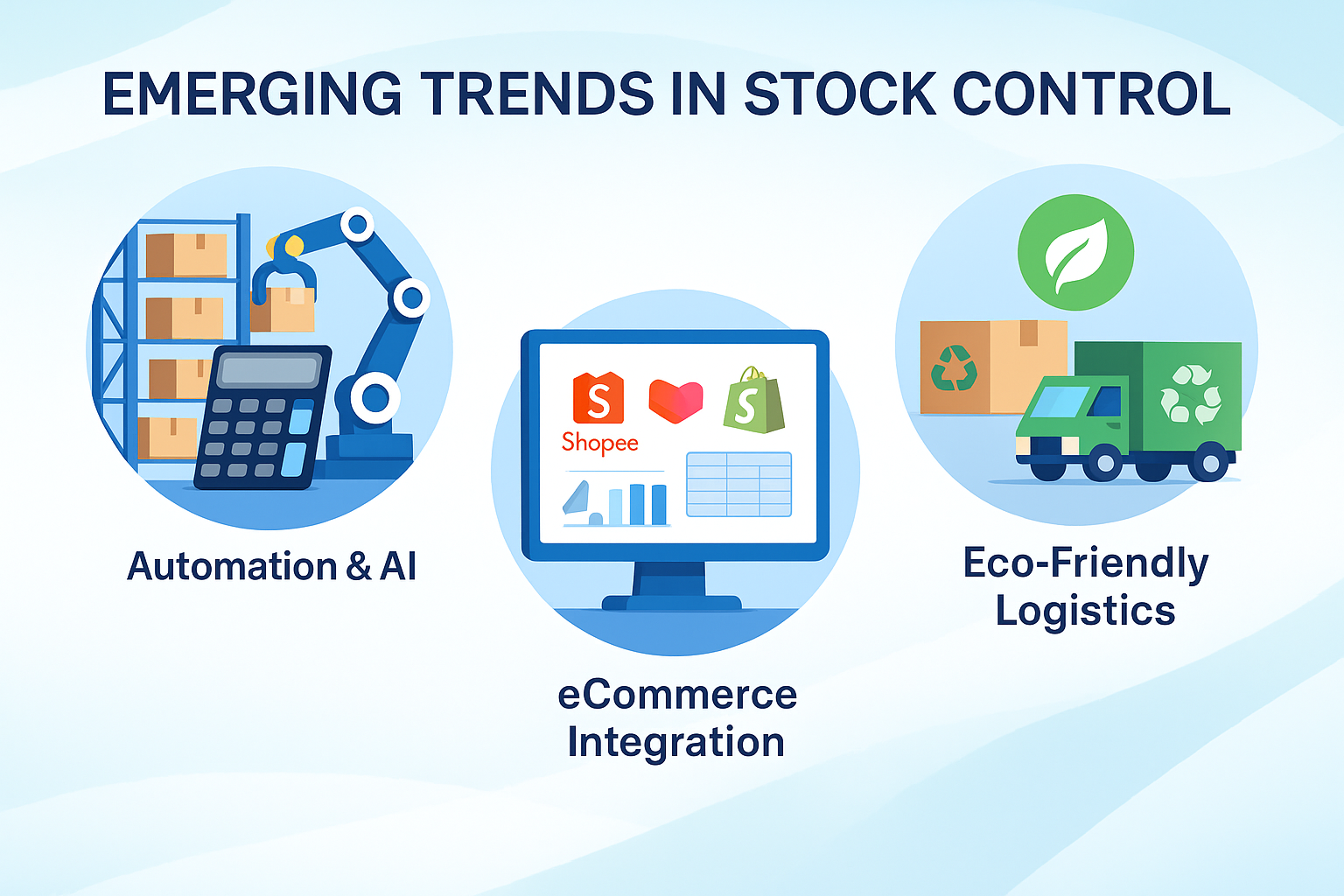
Let’s examine the key trends transforming stock control and how businesses can utilise them to maintain a competitive advantage:
Automation and AI are reshaping stock control by managing processes and enhancing precision. AI-powered systems offer advanced demand forecasting, enabling businesses to predict future demand more accurately.
By automating stock level management and optimizing reorder points, AI helps reduce human error and ensures that inventory levels always align with customer needs. Additionally, automated stock picking systems and robotic technologies are improving warehouse efficiency, cutting operational time, and enhancing order accuracy.
As the e-commerce sector continues its meteoric rise, effective stock control systems must integrate easily with online platforms. Integration with platforms like Shopify, WooCommerce, and BigCommerce ensures real-time synchronization of inventory across both physical and digital stores.
This integration prevents issues like overselling or stockouts, ensuring that businesses can maintain product availability at all times. With e-commerce sales in the Philippines projected to reach USD 30 billion by 2025, integrating these systems has never been more critical.
Sustainability is now becoming a core component of stock control strategies. Many businesses are adopting eco-friendly practices to minimize waste, optimize resources, and reduce their environmental impact. Practices such as reducing overstocking, using recyclable packaging, and choosing environmentally friendly shipping methods are becoming common. These strategies not only contribute to the environment but also help businesses stay efficient and cost-effective in a market where consumers increasingly value sustainability.
As we’ve explored, keeping up with trends like automation, AI, and sustainability is key to staying competitive in stock control. But even as these trends push businesses forward, the real turning point lies in taking action to transform your operations.
At Inspire Solutions, we specialize in turning the vision of optimized stock control into reality. With solutions designed to eliminate inefficiencies, we help businesses manage their inventory management, from sourcing to delivery.
At Inspire Solutions, we understand that stock control is one of the most critical yet challenging aspects of running a business. Poor inventory management can lead to stockouts, overstocking, and lost revenue.
Businesses with inefficient systems face up to 30% of their annual revenue loss due to these issues. That’s why we provide tailored solutions that help you optimize your inventory from sourcing to delivery.
What We Offer:
Looking to improve your stock control system?
Get in touch today for a quote and see how Inspire Solutions Asia can help you achieve smooth inventory management.
Effective stock control is crucial for any business seeking to remain competitive and maintain smooth operations. By implementing the proper methods and tools, companies can optimize inventory levels, reduce costs, improve customer satisfaction, and ensure timely order fulfillment.
The ability to stay on top of stock trends and integrate with modern systems can significantly enhance operational efficiency and overall profitability. As stock control continues to grow with advancements in technology and new market demands, staying ahead of trends will give your business a significant edge in the marketplace.
At Inspire Solutions, we specialize in helping businesses control and enhance their stock control processes with tailored solutions designed to meet your specific needs. Whether you’re dealing with seasonal demand, managing multiple warehouses, or looking for automation, we’ve got you covered. Ready to take your stock control to the next level? Schedule a Meeting with us today, and let’s discuss how we can help optimize your inventory management for better efficiency and growth.