
Managing inventory becomes more complicated as an ecommerce business expands its product range, sales channels, and order volume. Businesses must maintain enough stock to meet customer demand without tying up too much capital in products that may sell slowly. They also need reliable records to know which items are available, where they are stored, and when they need to be reordered.
Effective inventory management for ecommerce helps businesses coordinate stock levels with sales activity, purchasing decisions, and fulfillment requirements. However, inaccurate records, unpredictable demand, delayed replenishment, and limited warehouse visibility can make these tasks difficult.
Understanding these challenges is an important first step toward improving stock control. With clearer procedures, consistent inventory tracking, and better coordination between sales, purchasing, and warehouse teams, ecommerce businesses can make more informed decisions about their inventory.
Inventory management for ecommerce involves monitoring, organizing, and controlling the products a business holds for online sales. It includes tracking incoming stock, recording sales, monitoring available quantities, planning purchases, and identifying products that need replenishment.
The process extends beyond knowing how many items remain in storage. Businesses must also account for stock that has been reserved for orders, products awaiting inspection, damaged goods, returns, and inventory moving between locations.
For example, an ecommerce business may have 100 units of a product in its warehouse. If 15 units are reserved for unshipped orders and five are damaged, the quantity available for new orders may be lower than the physical stock count suggests.
Accurate records help businesses distinguish between physical quantities and stock available for sale. This visibility supports purchasing decisions, sales planning, and coordination with fulfillment activities.
Inventory records can become inaccurate when incoming deliveries are recorded incorrectly, product quantities are not updated promptly, or returns and damaged items are handled inconsistently. Manual data entry and disconnected systems can create additional opportunities for discrepancies.
These errors can have direct consequences for online sales. A website may show a product as available even though the warehouse has no sellable units left. Alternatively, stock may be available but remain unlisted because the recorded quantity is incorrect.
Businesses can address this challenge by establishing clear procedures for receiving, counting, adjusting, and recording inventory. Regular cycle counts can also help teams identify discrepancies without requiring a complete warehouse count every time.
When differences occur, staff should investigate the cause instead of simply changing the recorded quantity. This helps reveal recurring problems, such as incorrect receiving procedures or unrecorded stock movements.

Holding excess inventory can create financial and operational pressure. Money spent purchasing products remains tied up in stock that may take weeks or months to sell. Excess quantities can also occupy storage space needed for faster-moving products.
Overstocking often happens when businesses order more than demand supports, rely on outdated sales information, or fail to review how quickly individual products are selling. Promotions and seasonal buying decisions can also leave businesses with surplus stock when sales fall below expectations.
To manage this risk, businesses should review sales history, current stock levels, supplier lead times, and upcoming promotional activity before placing orders. They should also identify slow-moving products and investigate whether pricing, product visibility, seasonality, or changing customer preferences may explain weak sales.
Not every slow-moving item needs to be discounted immediately. The appropriate response depends on the product’s expected demand, storage requirements, remaining shelf life where relevant, and purchasing cost.
Stockouts occur when customers want to purchase a product that is unavailable. They can result in missed orders, delayed purchases, customer dissatisfaction, and additional work for support teams.
A product may run out because sales increase unexpectedly, suppliers deliver late, reorder points are too low, or stock records do not reflect actual availability. Businesses selling across multiple channels may face further complications if inventory is not updated consistently across their systems.
To reduce stockout risk, businesses should identify products that require closer monitoring. Popular items, products with long supplier lead times, and seasonal bestsellers may need different replenishment rules from products with predictable, slower sales.
Businesses should also account for stock already committed to orders and allow time for purchasing, delivery, and receiving. Reordering only after a product reaches zero leaves little room to respond to supply delays.
Demand forecasting helps businesses estimate future product requirements using information such as historical sales, seasonal patterns, current trends, and planned promotions. However, forecasts become less reliable when businesses rely on limited data or assume past sales will continue unchanged.
For example, a product may sell well during a major promotion but return to its usual sales level afterward. Using promotional sales alone to plan future purchases could result in excess inventory.
Businesses can improve forecasting by reviewing sales at the product level and considering factors that may change demand. These can include seasonal events, marketing campaigns, pricing changes, new product launches, and shifts in customer purchasing patterns.
Forecasts should also be reviewed regularly. They are planning tools rather than guarantees, so purchasing decisions should account for uncertainty and the potential cost of holding too much or too little stock.

Stock replenishment involves replacing inventory as products are sold or consumed. Without clear rules, businesses may reorder too late, purchase excessive quantities, or place orders without considering supplier lead times.
A structured replenishment process can help prevent these issues. Businesses can establish reorder points based on expected demand during the supplier’s lead time and an appropriate safety stock allowance.
For instance, a business may need to reorder a product before its remaining stock is exhausted because the supplier requires several days to deliver new units. The reorder point should reflect expected sales during that period, along with any buffer needed for uncertainty.
Replenishment rules should not be identical for every product. High-demand items, expensive products, seasonal goods, and products with unreliable supply may require different review schedules and stock thresholds.
Businesses should also review minimum order quantities, purchasing costs, storage capacity, and supplier reliability before confirming replenishment orders.
Inventory information becomes less useful when teams cannot see stock movements or confirm where products are stored. A business may have sufficient inventory overall but still struggle to locate specific items, identify discrepancies, or determine which quantities are ready for fulfillment.
These problems can become more pronounced as product ranges grow or businesses begin operating across several storage locations. Separate spreadsheets and disconnected systems may also create conflicting records.
Businesses should establish consistent processes for recording receipts, transfers, picking activity, returns, and stock adjustments. Clear product identification and organized storage locations can help staff find items and record movements correctly.
Reliable warehouse inventory records should reflect both quantities and locations. This helps teams understand what is available, where it is held, and whether additional action is required before products can be sold or shipped.
Addressing inventory problems requires more than correcting individual stock discrepancies. Businesses need repeatable processes that help prevent errors and support consistent decisions.
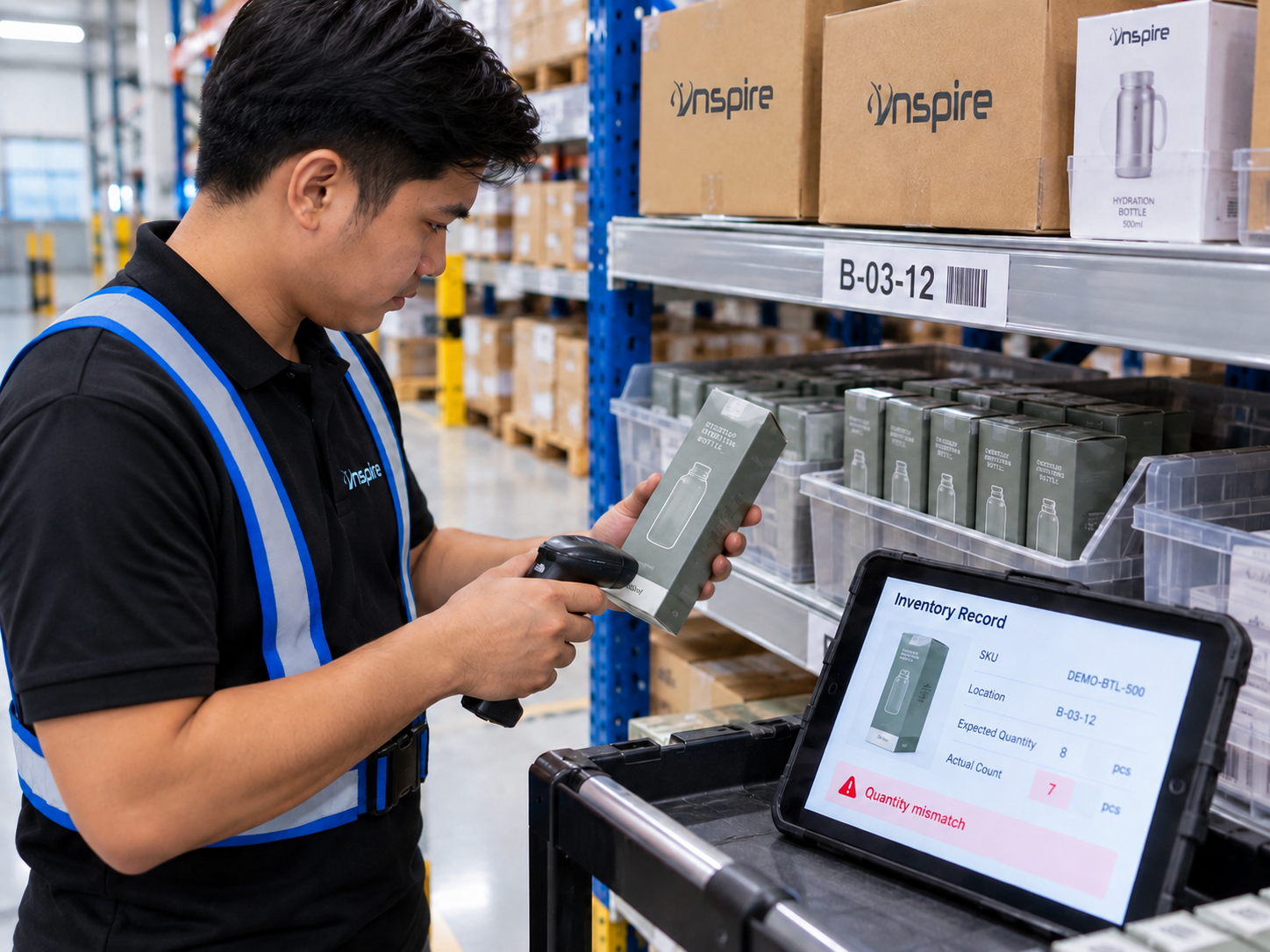
Record stock movements as they happen, including deliveries, sales, returns, transfers, and adjustments. Assign clear responsibilities for updating records and investigating discrepancies.
Regular cycle counts can help verify recorded quantities against physical stock. Businesses should prioritize products with frequent discrepancies, high sales volumes, or greater financial value.
Use historical sales data alongside current market conditions to estimate future demand. Review forecasts when promotions, seasonality, or changes in customer behavior may affect sales.
Comparing expected demand with actual sales can help businesses identify when purchasing assumptions need to change. This can reduce the risk of relying on outdated forecasts when planning inventory.
Set reorder points and safety stock levels according to product demand, supplier lead times, and the consequences of running out. Review these settings when sales patterns or supply conditions change.
A consistent process makes it easier for purchasing teams to determine which products need attention and when an order should be placed.
Review products that remain in storage longer than expected. Useful indicators include sales velocity, stock age, inventory turnover, and the quantity remaining compared with forecast demand.
The findings can inform decisions about future purchasing, promotions, product assortment, and stock allocation. Businesses should avoid automatically replenishing products simply because they have reached a familiar ordering schedule.
Inventory records should align with warehouse receiving, storage, picking, packing, and dispatch procedures. Teams need to understand when stock becomes available for sale and how reserved, damaged, or returned products are recorded.
Clear communication between purchasing, sales, and warehouse staff can help prevent conflicting decisions. It also makes it easier to investigate discrepancies and respond to changes in order volume.
Inventory tracking provides a record of stock quantities and movements throughout the business. Depending on the systems and procedures used, it can help teams monitor incoming deliveries, transfers, sales, returns, and available quantities.
Reliable tracking makes it easier to identify discrepancies, locate products, and determine when replenishment may be needed. It also supports communication between purchasing and warehouse teams by giving them a more consistent view of stock information.
Businesses should choose tracking procedures and technology that match their product range, transaction volume, and operational complexity. Smaller operations may be able to manage some activities with well-maintained records and disciplined checks, while growing businesses may benefit from more connected inventory and warehouse systems.
A warehouse management system may support inventory visibility by recording warehouse transactions and helping teams manage stock locations and movements. The specific functions available depend on the system and how it is configured.
Technology alone cannot guarantee accurate inventory. Staff still need clear procedures, correct product information, and consistent transaction records for inventory data to remain useful.
Ecommerce businesses should review their inventory processes when recurring problems begin affecting sales, storage, purchasing, or fulfillment. Common warning signs include frequent stock discrepancies, repeated stockouts, growing quantities of slow-moving products, and unexpected purchasing costs.
A review may also be appropriate when a business expands its product range, adds sales channels, changes suppliers, or experiences a sustained increase in order volume. Processes that worked for a small product catalog may become difficult to manage as transaction volumes grow.
During the review, businesses should examine stock accuracy, replenishment rules, forecasting methods, supplier lead times, storage capacity, and how inventory information moves between systems and teams.
If internal resources or storage capacity are becoming constraints, businesses may also evaluate external warehousing support. The right arrangement depends on product requirements, expected order volume, service scope, and the provider’s actual capabilities.
The appropriate frequency depends on sales volume, product value, stock movement, and the risk of discrepancies. Regular cycle counts can help businesses monitor selected products throughout the year, while higher-risk or fast-moving items may need more frequent checks.
Inventory tracking records current stock quantities and movements. Demand forecasting estimates how much customers may purchase in the future. Businesses use both to understand current availability and plan future purchasing and replenishment decisions.
Businesses can review sales trends, improve demand estimates, monitor slow-moving products, and adjust purchasing quantities to reflect expected demand. Reviewing supplier lead times and existing stock before reordering can also help prevent unnecessary purchases.
A reorder point is the stock level at which a business should consider placing a replenishment order. It generally accounts for expected demand during supplier lead time and may include safety stock to provide a buffer against unexpected demand or delivery delays.
Warehouse technology can support more consistent transaction recording, stock visibility, and location management. However, its effectiveness depends on correct setup, reliable data, suitable processes, and staff following established procedures.

Managing ecommerce inventory requires a balance between product availability, purchasing costs, storage capacity, and fulfillment requirements. Inaccurate records, unreliable forecasts, and poorly timed replenishment can make that balance difficult to maintain.
By reviewing sales patterns, standardizing inventory procedures, and improving visibility across warehouse activities, businesses can make more informed stock decisions. The right combination of processes and technology depends on each operation’s products, order volume, and growth plans.
Businesses evaluating ways to improve inventory visibility and warehouse coordination can explore warehousing and technology solutions that align with their operational requirements.
Inspire E-Commerce Solutions Inc.
Warehouse 4 & 5, C Teknik Industrial, 143 P. Gregorio Street, Valenzuela,
1442 Metro Manila
inspiresolutions.asia
